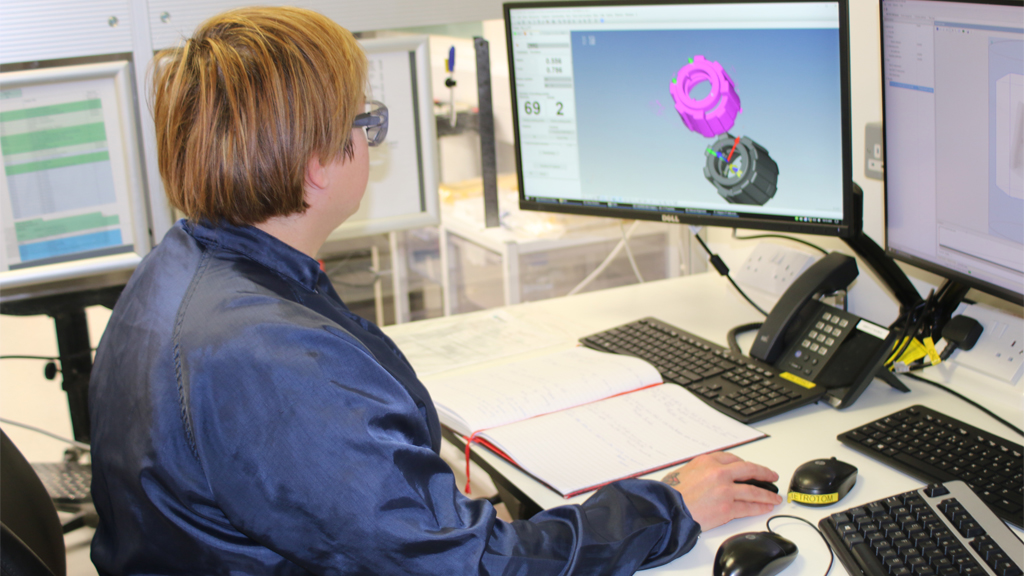
CT Scanning – Transforming Metrology Capacity and Capability.

The Context

Quvara manufactures and sources a wide range of plastic moulded components and assemblies for medical devices, all of which required routine dimensional inspection during manufacturing and at goods receipt.

Due to the complexity of the parts and the tight tolerances required for final product performance, inspection processes were both technically demanding and critical to maintaining quality standards.

The Challenge

Existing inspection methods relied on a combination of touch Coordinate Measuring Machines (CMMs), optical systems, and manual gauges.

This created several inefficiencies:

  • Multiple handling steps across different inspection technologies
  • Complex planning to manage inspection sequences and avoid bottlenecks
  • Increasing volumes of parts requiring inspection with no increase in metrology capacity

Capacity constraints were becoming a significant concern, with utilisation forecast to reach 86%, leaving minimal headroom for future growth.

Additionally, the existing metrology infrastructure presented further risks:

  • Ageing equipment with declining OEM support
  • Large laboratory footprint, making physical expansion necessary to scale capacity

Together, these factors highlighted the need for a more scalable, efficient, and future-proof inspection solution.

Our Solution

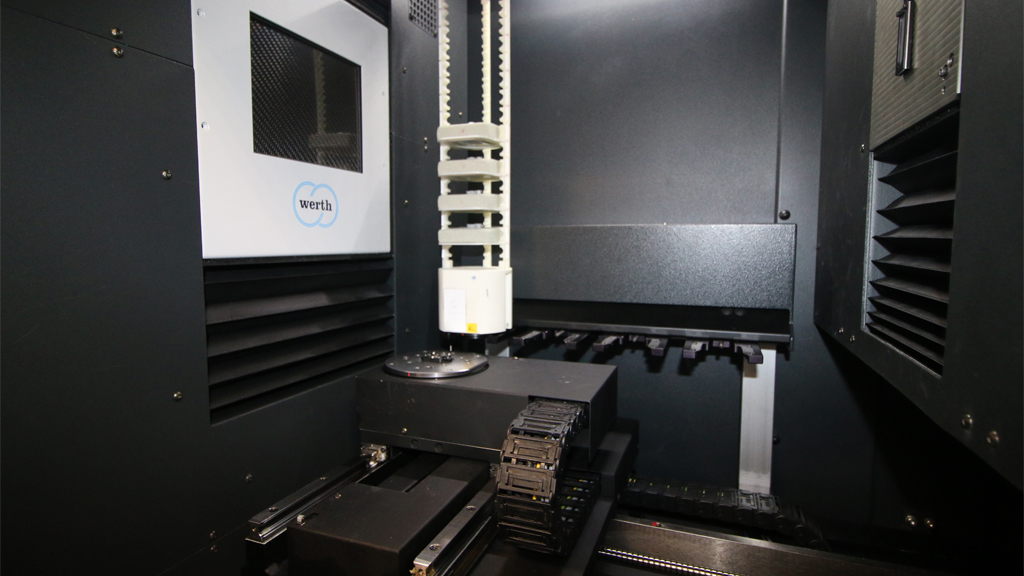
The approach taken was to evaluate and implement an advanced CT (Computed Tomography) scanning strategy for high-volume inspection of complex moulded parts.

A cross-functional team assessed both upgrading existing technologies and adopting alternative approaches, ultimately selecting CT scanning as the optimal solution due to its flexibility, accuracy, and scalability.

To ensure the solution met operational and regulatory needs, key requirements were defined:

  • Capability to measure complex geometries with high accuracy
  • Automated operation with minimal manual handling
  • Scalability to support future product introductions and volume increases
  • Integration with electronic batch record systems

A partnership was established with a specialist supplier to develop a tailored system, incorporating:

  • Automated analysis, removing the need for manual data processing
  • High-capacity pallet systems, enabling the inspection of large batches (up to ~140 parts per run)
  • Automated data export directly into electronic batch records
  • Integrated data trending and reporting tools
  • Seamless methodology transfer, including measurement system analysis and equivalence studies

This solution provided a step-change in both capability and efficiency compared to traditional metrology systems.

Capabilities Used

Quvara deployed a combination of engineering, quality, and digital integration expertise:

  • Cross-functional technology evaluation and selection
  • Advanced metrology and CT scanning integration
  • Automation and high-throughput inspection system design
  • Data integration with quality and electronic batch systems
  • Measurement system validation, including MSA and equivalence
  • Supplier partnership and co-development of tailored solutions

This ensured the final system was not only technically capable but fully aligned with operational and regulatory requirements.

Results and Outcomes

The implementation of CT scanning delivered immediate and measurable improvements:

  • Four CT systems installed and validated, replacing the footprint of three traditional CMMs
  • Significant increase in available metrology capacity
  • 20% reduction in inspector utilisation, driven by simplified workflows and reduced handling
  • Enhanced capability to measure complex parts consistently and efficiently
  • Improved scalability, supporting future product introductions and higher inspection volumes

Beyond capacity gains, the solution strengthened technical robustness and quality assurance, positioning the operation for continued growth while maintaining high compliance standards.

Do you have a problem that needs solving?

Got a question?

Hopefully the below FAQ’s will answer any questions you have, if not, head over and Ask a question, any question on our contact page.

Our engineering and validation teams can implement rapid, low-risk solutions that increase capacity within tight timelines.

We design solutions that increase effective capacity using existing infrastructure, minimising capital investment and avoiding long validation cycles.

All Quvara solutions are developed within a fully compliant framework, ensuring scalability without compromising quality or regulatory standards.

Our in-house engineering, quality, and manufacturing teams work together to design, validate, and deploy solutions at pace.

We focus on automated, integrated solutions that enhance output without increasing labour requirements.

We design staged, low-risk implementation plans that protect ongoing production while scaling capacity.

Quvara combines engineering insight, validated manufacturing, and scalable infrastructure to support your growth, now and long term.